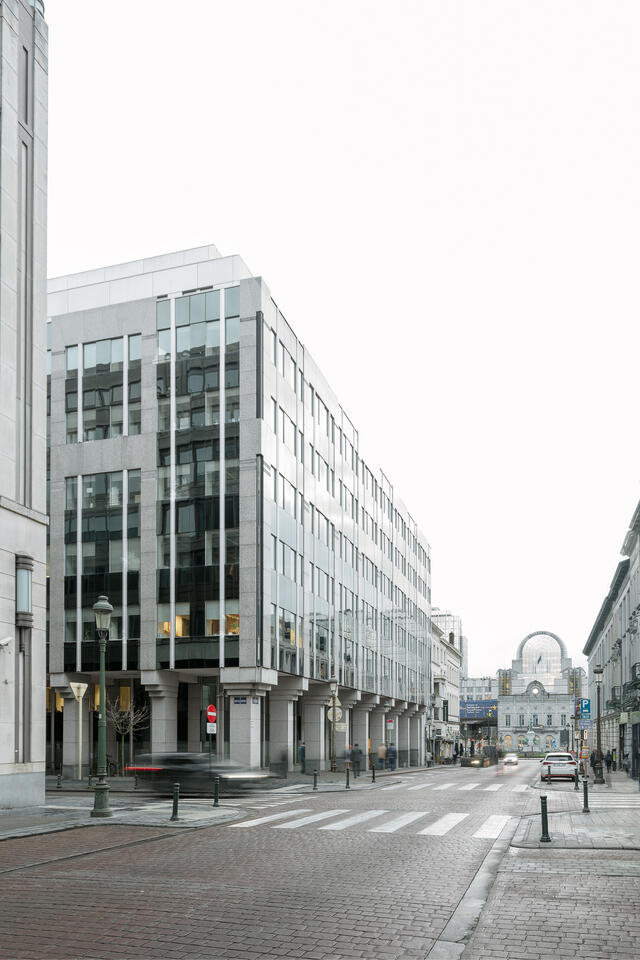
In the heart of the European Quarter, between Place du Luxembourg and Square de Meeûs, LUX46 proposed transforming a 1970s office building into a mixed-use and open space, revealing its original rationalist architecture and enhancing its urban potential. Behind the 1990s façade lies a robust building, offering the opportunity for a sustainable and exemplary project..
The intervention aims to reconnect the building with its prestigious and lively urban context. Opening the base onto the street, combined with visual and pedestrian passages, links the public space to a landscaped interior garden. The gable facing Place du Luxembourg, long blind, has been redesigned to become a true urban marker, engaging in dialogue with the surrounding heritage. The existing volume is sculpted to reduce its excessive depth and create high-quality residential units, while better integrating into the built fabric through a stepped massing.
The base, extending from levels -2 to +1, hosts a diverse program designed to animate the surroundings: retail and horeca along Rue du Luxembourg, hybrid housing and facilities on Rue Marie de Bourgogne, and a cultural space at the corner serving as an anchor point. The partially transformed basements accommodate generous bicycle facilities, new public amenities, and cultural spaces, while minimizing car parking.
The conversion takes advantage of the existing structural grid to provide cross-ventilated or dual-aspect apartments, each extended by an outdoor space. The restoration of the original façades, combined with a new set-back thermal envelope, allows for the creation of private loggias and balconies. A variety of typologies—from studios to family apartments—ensures high flexibility and meets the diverse needs of residents.
The interior courtyard becomes a true green lung, designed as an ecological extension of the Maelbeek valley. The garden, conceived in a naturalistic manner, combines the preservation of large cedars, the creation of varied environments (wet, shaded, sunny), and the integration of natural rainwater management. On the roof, new landscaped areas host vegetable gardens, shared terraces, and social spaces, offering dual orientations: towards the tranquility of the courtyard and the rooftops of Brussels.
The project follows a circular economy approach: the existing concrete structure is preserved, load-bearing façades are reused, and finishing materials are valorized. New lightweight steel and timber structures complement the ensemble, reducing carbon impact and facilitating implementation. The high-performance envelope, integrated rainwater management, green roofs, and potential geothermal systems contribute to an ambitious bioclimatic strategy, ensuring comfort and durability.
Structural Stability – WOW Engineering
1050 Ixelles
Belgium